
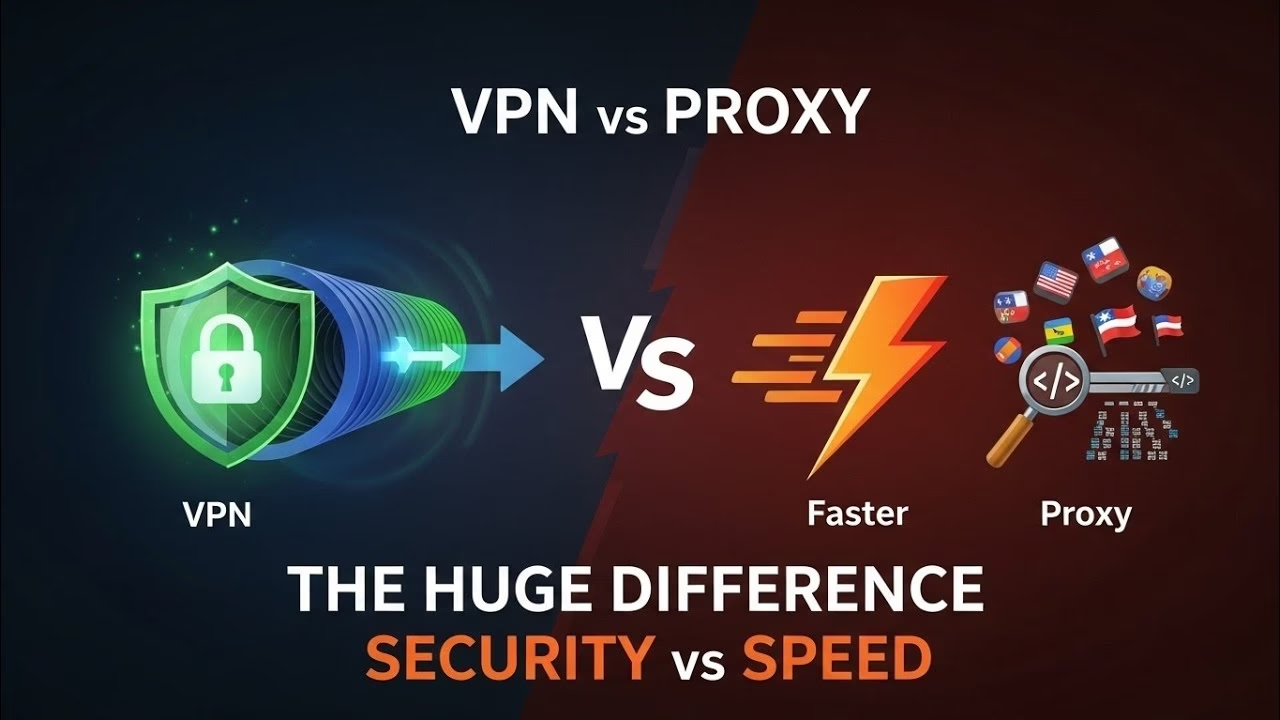
VPN vs Proxy: There’s a HUGE Difference – Security, Speed, and Which One You Should Get

In modern network administration and digital connectivity, configuring secure transmission lines is key to maintaining privacy and optimal data performance. This comprehensive guide focuses on VPN vs Proxy: There’s a HUGE Difference – Security, Speed, and Which One You Should Get, outlining the exact configuration parameters, setup workflows, and troubleshooting methods required to deploy this solution successfully.
Table of Contents
- Video Tutorial Walkthrough
- Step 1: System Requirements & Prerequisites
- Step 2: Configuration & Implementation Steps
- Step 3: Verification & Latency Testing
- Frequently Asked Questions & Troubleshooting
Video Tutorial Walkthrough
Step 1: System Requirements & Prerequisites
To configure and run the setup described in the tutorial, ensure you have the following prerequisites prepared in your work environment:
- An active mobile carrier data connection or local Wi-Fi.
- Access to your device’s APN (Access Point Name) configuration settings.
- Valid proxy server host IP address and port parameters.
Step 2: Configuration & Implementation Steps
You ever find yourself wondering why your favorite show is on a streaming service in another country, but you can’t get it? Or maybe how some companies just seem to pull massive amounts of data off the web? Well, the answer usually comes down to two tools that on the surface seem almost identical, but are actually worlds apart.
VPNs and proxies. Today, we’re going to break it all down, right? So, that’s the big question, isn’t it?
If they both hide where you are and give you a new IP address, what is the actual difference? I mean, why would you ever pick one over the other? That is exactly what we are going to unpack right now.
You know, it’s really easy to see why people get them confused. At a glance, they both look like they do the exact same thing. They put a mask on your online identity.
But as you’re about to see, what’s going on behind that mask is a completely different story. Okay, so here’s the one thing they absolutely have in common. They both act as a middleman.
They take your internet traffic and route it through a remote server somewhere else in the world. So if you connect to a server in say Tokyo, any website you visit thinks you’re actually sitting in Tokyo. And yeah, this is the part you probably heard of, right?
This is how you can get access to another country’s streaming library or check out a website that might be blocked where you are, but that is literally where the similarities stop. Dead. So if changing your location is just the tip of the iceberg, what’s hiding underneath?
Well, it all starts with the VPN’s main job, its whole reason for being building a fortress around your data. I mean, the name pretty much gives the game away, doesn’t it? Virtual private network.
Its entire purpose is to create a secure private connection for you over the very public and very unsecured internet. It’s a tool that was built from the ground up for privacy. The magic word here, the thing that makes it all work is encryption.
And the absolute best way to picture this is to think of your regular internet traffic like driving on a wide open highway. Anyone can look over and see who you are and where you’re going. A VPN, on the other hand, puts your car inside a private armored tunnel.
So, here’s how that actually works. Before any data even leaves your phone or your computer, the VPN wraps it up in this powerful layer of encryption. Then, it travels through that secure tunnel to its destination.
And the crucial part is nobody can see inside. Not your internet service provider, not the government, and certainly not some hacker at the coffee shop sniffing the public Wi-Fi. So, when you put it all together, a VPN is your go-to for total privacy and ironclad security.
It’s absolutely essential if you ever use public Wi-Fi, and it’s a critical tool for anyone working remotely who needs safe access to company files. Honestly, being able to watch geoblocked content is almost just a cool side effect of its main mission, which is security. Okay, so we’ve got VPNs nailed down.
They’re all about your personal security. But what about proxies? This is where we do a complete 180.
But purpose is totally different. It’s not about one person’s privacy. It’s all about operating on a massive, massive scale.
I mean, we are not talking about just one or two connections here. Think bigger. Think hundreds, even thousands, all at once.
Welcome to the world of proxies. Yeah, hundreds of different IP addresses all being managed and running at the exact same time. So, while a VPN is designed for just one user who wants privacy, a proxy service is built to be an orchestra conductor for a huge volume of simultaneous data streams.
And you might be wondering, why on earth would anyone need that kind of power? Well, think about something like web scraping. Let’s say you’re a travel company and you want to gather thousands of flight prices from an airlines website.
If that site sees all those requests coming from one IP address, boom, you’re blocked instantly. But with proxies, you can spread those requests across hundreds of different IPs, making it look like hundreds of different people are just checking prices. The same idea applies to doing market research or managing a ton of social media accounts from one computer without getting flagged.
All right, now that we understand they’re completely different jobs, let’s put them side by side. It’s time for the head-to-head showdown. This table just lays it all out crystal clear.
The VPN is your personal bodyguard. Its main goal is security and privacy. The proxy is like a fleet manager.
Its main goal is scale and data gathering. Because of that, the VPN has high security, that encryption we talked about, which makes it a bit slower. A proxy usually skips encryption because it’s all about speed.
And here’s another big one. A VPN usually protects your entire device with one click, while a proxy is often set up just for one specific app, like your web browser, for a specific task. Okay, so with all that on the table, how in the world do you choose the right tool for the job?
Well, it’s actually way easier than you might think. It just comes down to what you’re trying to do. All right, scenario one.
Let’s say your number one goal is protecting your personal data. You want to hide what you’re doing from your internet provider, and you definitely want to be safe when you’re using that sketchy coffee shop Wi-Fi. Yeah, the answer here is a no-brainer.
You need a VPN. End of story. But what if that’s not you at all?
What if you’re running a business and you need to scrape thousands of prices off a competitor’s site, or you’re a marketing manager trying to run 50 different social media accounts? Then a proxy is the tool you want. It was built from the ground up for exactly that purpose.
a VPN would just fall over trying to handle that kind of operation. Okay, now for the tricky one, the gray area. What if all you really want to do is just watch that show that’s only available in another country?
Because here, technically, either one could get the job done. Look, for most people, a VPN is going to be the simplest choice. You download an app, click a button, you’re good to go.
But it’s worth knowing about a special type called a residential proxy. It uses an IP address from a real home internet connection. So to the streaming service, you look just like a regular customer.
This makes it way harder for them to detect and block, and it’s often faster. So for the average person, a VPN is fine, but a residential proxy can give you a better shot. And that really brings us to the bottom line.
When you’re trying to decide between these two powerful tools, you just have to ask yourself one simple question. Are you trying to protect your own single private journey online, or are you trying to manage a massive fleet operation? The answer to that question tells you everything you need to
Step 3: Verification & Latency Testing
Once the initial setup and configuration steps are completed, verify the connection status:
- Toggle the master connection switch in the client app dashboard.
- Monitor the live connection log. It should show a successful handshake and display a ‘Connected’ status.
- Navigate to a public IP verification tool (e.g. whoer.net) to verify that your original IP address is masked.
Frequently Asked Questions & Troubleshooting
1. Why is the proxy connection slow or lagging?
Proxy routing speed depends on server bandwidth and physical distance. To resolve slow speeds, choose a proxy server geographically closer to you. Additionally, ensure the target port isn’t rate-limited by your service provider.
2. How do I configure this proxy inside my Wi-Fi settings?
Go to your phone’s Wi-Fi settings, long-press on your active network, select Modify Network, toggle Advanced Options, set Proxy to Manual, and input the server host and port details.
3. Can a proxy mask all application traffic?
Proxies configured inside browser settings or Wi-Fi configurations only encrypt traffic for applications that support SOCKS or HTTP proxy routing. For full device encryption, route traffic through a system-level VPN client.