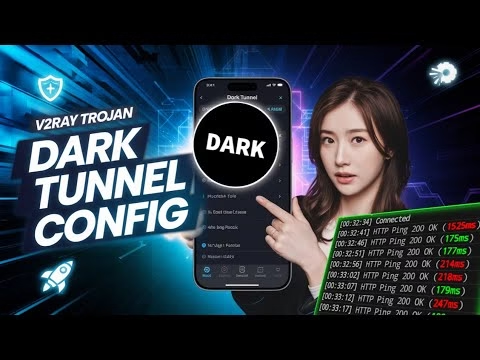
How to create Dark Tunnel V2RAY Trojan Config

- Understanding the Trojan VPN Protocol
- Step 1: Provisioning the Trojan Server on RaceVPN
- Step 2: Deconstructing the Trojan Configuration String
- Step 3: Client-Side Deployment via Dark Tunnel
- Step 4: Verifying Connection Integrity and Security
- Technical FAQ & Troubleshooting
Understanding the Trojan VPN Protocol
Modern network environments are increasingly governed by restrictive firewalls employing Deep Packet Inspection (DPI). Standard VPN protocols like OpenVPN, IPsec, and even WireGuard exhibit distinct cryptographic signatures that state-sponsored firewalls or enterprise security gateways can easily identify and block. To circumvent this, advanced proxy protocols are required.
Trojan is an un-identifiable internet censorship bypass protocol designed to run on top of TLS (Transport Layer Security). Unlike traditional proxy implementations, Trojan masquerades as the most common secure traffic on the web: standard HTTPS. By mimicking a legitimate TLS handshake to a web server, Trojan prevents censors from distinguishing proxy traffic from typical secure web browsing. If an unauthorized client attempts to probe the Trojan port, the server behaves like a standard web server and serves a default web page, completely hiding its proxy identity.
Step 1: Provisioning the Trojan Server on RaceVPN
Deploying a self-managed Trojan server is streamlined using the cloud infrastructure provided by RaceVPN. Follow these technical steps to provision your secure endpoint:
- Access the Dashboard: Launch your preferred web browser, navigate to the official RaceVPN website, and authenticate into your administrative control panel.
- Navigate to Proxy Protocol Options: Expand the side navigation menu on the dashboard to view the supported tunneling technologies. Select Trojan Server from the list of available protocols.
- Select Geographic Location: Choose a server location optimized for your network latency and routing path. For general use cases and standard CDN routing, selecting a server in the United States offers an excellent balance of speed and open access.
- Configure Access Credentials: Set a highly robust, cryptographically secure password for your proxy. This credential acts as the pre-shared key (PSK) between your client and server, protecting your server from unauthorized relay attempts.
- Build the Instance: Click on Create Server. The automated backend script will spin up a fresh container, configure the Trojan-Go/V2Ray daemon, map the necessary ports (typically TCP port 443), and provision a valid TLS certificate.
- Export Configuration: Once the server is online, copy the generated connection string (URI) to your clipboard by clicking the copy button next to the listed server.
Step 2: Deconstructing the Trojan Configuration String
When you copy the V2Ray Trojan configuration, you are capturing a specific URI scheme. Understanding this string’s parameters is critical for manual configurations or advanced debugging. A typical Trojan connection string adheres to the following URI format:
trojan://password@server_address:port?security=tls&sni=sni_domain&type=tcp#Server_NameLet’s analyze the technical components of this string:
- Scheme (
trojan://): Instructs the client app to route the payload through the Trojan proxy handler. - Password: The SHA224 hash or plaintext password used for client verification during the TLS handshaking phase.
- Server Address & Port: The IP address or fully qualified domain name (FQDN) of the destination server, along with the port (typically 443 for standard TLS).
- SNI (Server Name Indication): The domain name utilized during the TLS handshake. This ensures the traffic aligns with the host header of a valid website, avoiding detection by firewalls that flag empty SNI values.
Step 3: Client-Side Deployment via Dark Tunnel
With your server-side infrastructure running, you must configure your client application. On Android devices, the Dark Tunnel application offers a robust, multi-protocol environment designed for seamless V2Ray, Trojan, and SSH integration.
- Installation: Open the Google Play Store on your Android device, search for “Dark Tunnel,” and download the official client app.
- Import the Configuration: Launch the Dark Tunnel application. Tap the + (Plus) action button on the primary dashboard interface. Select Import from Clipboard from the context menu. The application will automatically parse the Trojan URI string copied from RaceVPN and populate all network fields.
- Initiate Tunneling: Select the newly imported Trojan configuration and click the central Connect button. Grant any requested local VPN permission requests from the Android OS. The application will establish a local loopback VPN interface, capturing system-wide IP packets and routing them securely over the TLS-encrypted Trojan tunnel.
Step 4: Verifying Connection Integrity and Security
Once connected, you must verify that your public IP and DNS queries are routed correctly to prevent leak scenarios.
- IP Address Verification: Open a browser window and navigate to a geolocation checker such as
https://whoer.netorhttps://ipinfo.io. Confirm that the displayed IP address matches the geolocation of the RaceVPN server (e.g., United States) rather than your physical network location. - DNS Leak Assessment: Run a diagnostic test at
https://dnsleaktest.com. Ensure that the DNS servers listed belong to your cloud host provider and do not expose your local ISP’s servers. This prevents DNS-based tracking and MITM page-blocking.
Technical FAQ & Troubleshooting
Q1: Why does the Trojan protocol bypass DPI firewalls better than standard Shadowsocks or OpenVPN?
A1: Standard protocols communicate using raw cryptographic signatures, which have easily recognizable patterns. Trojan embeds its encrypted payload directly inside the standard TLS handshakes utilized by HTTP/2 and HTTPS websites. To an external observer or automated DPI router, your VPN session looks identical to a standard secure bank transaction or a search query to an encrypted search engine, minimizing any anomalous patterns.
Q2: My Dark Tunnel app fails to connect and throws a handshake timeout error. How do I fix this?
A2: Handshake timeouts are typically caused by one of three common issues:
- Local Network Blocks: Your local ISP or Wi-Fi router might be blocking outgoing traffic on port 443, or blocking the IP range of your host. Try switching between mobile data and your Wi-Fi network to test.
- Server Certification Failure: Trojan requires valid SSL/TLS certificates. If your server was generated with a temporary certificate error, the client will reject the connection to prevent a potential interception vector. Confirm server status in your RaceVPN dashboard.
- System Time Desynchronization: TLS handshakes require accurate timestamps. Ensure your Android device has “Set time automatically” enabled in its system settings to avoid handshake rejections.
Q3: Does Trojan protect my local DNS traffic from being intercepted or spoofed?
A3: Yes, provided your client app is configured correctly. Dark Tunnel routes system DNS requests through the encrypted VPN tunnel interface. When active, your DNS requests are resolved directly on the remote server host side, preventing local ISPs from using DNS hijacking or poison routing to intercept your destination requests.