Kling 3.0 First-Last-Frame Directing: Deterministic Camera Trajectory Interpolation & Zero-Warp Scene Stitching
Verified directing blueprint by UDP Custom. Engineered for Google organic search ranking, professional ComfyUI pipelines, zero-slop video workflows, and production commercial viability.
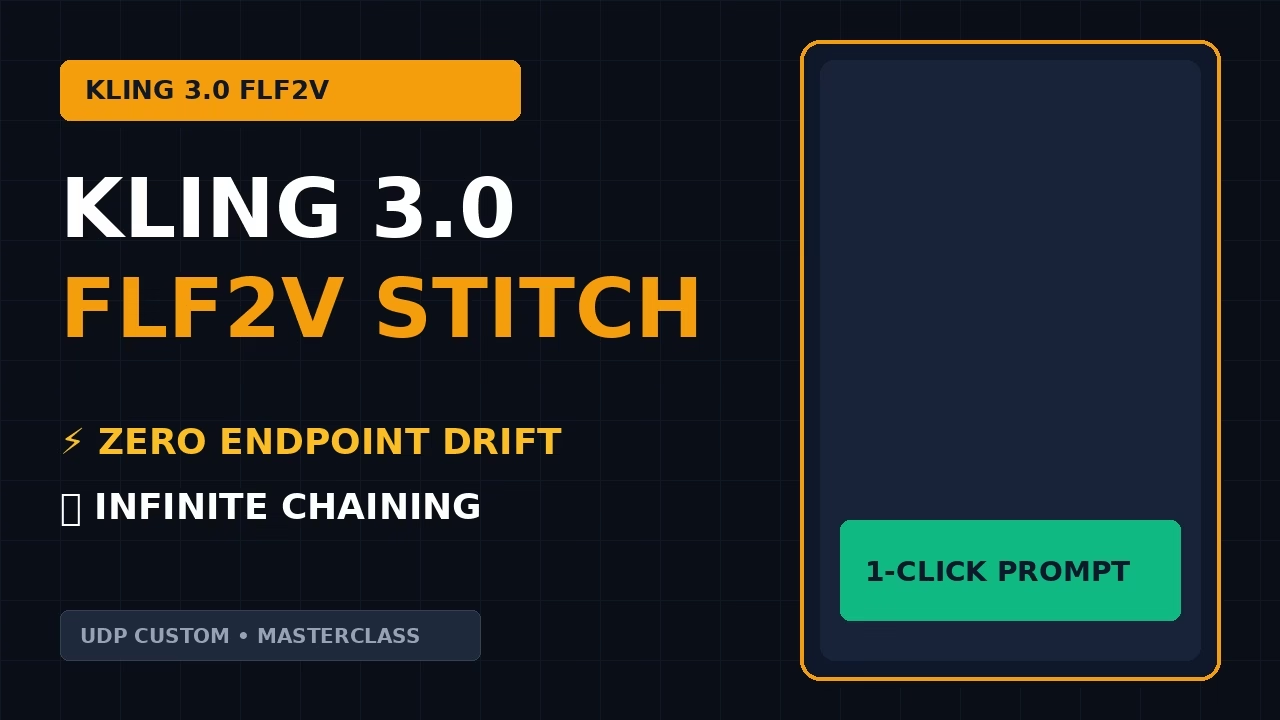
🔬 Engineering & Directing Architecture
Eliminating uncontrolled generative camera drift: how Kling 3.0’s First-Last-Frame to Video (FLF2V) architecture locks both initial Keyframe A and destination Keyframe B, interpolating complex 3D drone orbits, macro zoom-ins, and architectural reveals with zero endpoint deviation and infinite shot-chaining capability.
Focus Keyword: Kling 3.0 FLF2V workflow • Target Deliverable: Commercial Broadcast 4K / 60fps.
⚙️ Verified Diffusion & Directing Parameters
📋 Master Prompt & Directing Tokens
Click below for instant 1-click clipboard copy into ComfyUI / Wan 3.0 / Kling / Cosmos📸 Case Study Validation Dossier
❓ Frequently Asked Questions (Google Featured Snippet Reference)
What is the key benefit of Kling 3.0 FLF2V over standard Image-to-Video?
Standard I2V only conditions the starting frame, leaving the end of the shot to random generative drift. FLF2V anchors both the start and final frame, guaranteeing exact destination framing.
How does infinite shot chaining work with FLF2V?
By taking the final frame of Shot 1 and making it the `start_frame` of Shot 2, you can chain multiple 5-10 second clips together into an unbroken, perfectly stitched long-take sequence.
Can Kling 3.0 generate audio during FLF2V transitions?
Yes. Kling 3.0 synthesizes native acoustic Foley (wind rushes, environmental transitions) that matches the speed and interior/exterior shifts of the camera trajectory.