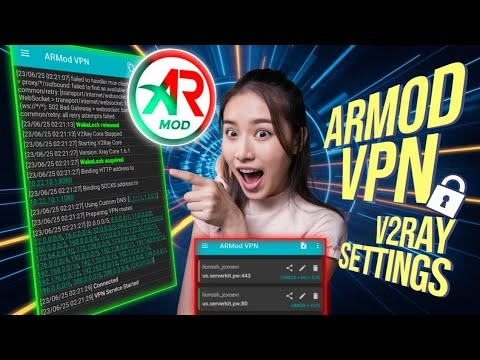
How to create Armod VPN v2ray configs | TLS WS settings

In an era of rising state-sponsored censorship, advanced deep packet inspection (DPI), and ISP-level content filtering, relying on traditional VPN protocols (like PPTP, L2TP, or even OpenVPN) is often insufficient. Advanced network firewalls easily identify and throttle these protocol signatures. To maintain digital privacy and uninterrupted access to the global internet, network administrators and privacy advocates turn to V2Ray.
V2Ray is a sophisticated platform for building secure network tunnels. When paired with WebSocket (WS) transport and Transport Layer Security (TLS), it encapsulates your traffic inside standard HTTPS web traffic. To any external observer or DPI firewall, your VPN tunnel looks exactly like a normal secure connection to a web server (such as an e-commerce site or a bank), making it virtually impossible to block without shutting down standard secure web services.
This technical guide provides an authoritative, step-by-step walkthrough on generating a high-performance V2Ray server config using the LionSSH platform, installing the robust Armod VPN client, and configuring advanced TLS/WS parameters to establish a secure, censorship-resistant tunnel.
Table of Contents
- 1. Understanding the Architecture: V2Ray, TLS, and WebSockets
- 2. Generating Your V2Ray Server on LionSSH
- 3. Sourcing and Installing the Armod VPN Client
- 4. Importing and Configuring the Profile in Armod VPN
- 5. Advanced Tuning: SNI, Bug Hosts, and Path Optimization
- 6. Troubleshooting & Technical FAQ
1. Understanding the Architecture: V2Ray, TLS, and WebSockets
Before jumping into deployment, it is vital to understand why the V2Ray + WS + TLS stack is so effective. V2Ray utilizes customizable protocols like VMess (a proprietary encrypted communication protocol) or VLess. These protocols can be transported over different underlying network protocols.
When configured with WebSocket (WS) transport, the client establishes its connection with an HTTP handshake, which is then upgraded to a persistent WebSocket connection. When wrapped inside TLS, the entire payload is encrypted using asymmetric key cryptography over standard port 443 (HTTPS). This configuration provides several key advantages:
- DPI Evasion: The traffic flow mirrors legitimate web traffic. DPI systems only see standard TLS handshakes and encrypted application data.
- CDN Compatibility: Because it uses standard WebSocket over TLS, this traffic can be proxied through Content Delivery Networks (CDNs) like Cloudflare, hiding your real destination server IP.
- Port Sharing: It runs seamlessly over standard port 443, which is almost universally open in public and restricted networks.
2. Generating Your V2Ray Server on LionSSH
To establish our secure tunnel, we require a VPS (Virtual Private Server) configured as a V2Ray endpoint. LionSSH simplifies this by offering managed, high-performance V2Ray server endpoints globally. Follow these steps to provision your server:
- Navigate to the Platform: Open your preferred secure web browser (such as Google Chrome, Brave, or Firefox) and navigate to the official LionSSH website.
- Locate the Navigation Menu: On the homepage, tap the hamburger menu button (typically found at the top right of the viewport) to reveal the navigation options.
- Select V2Ray: Click on the V2Ray option in the menu. This redirects you to the V2Ray server management portal.
- Select Server Location: You will see a list of global server locations (e.g., Singapore, Germany, USA). For optimal speeds and reduced latency (RTT), select a server geographically closest to your physical location. Click Select on your chosen node, then click Next.
- Configure & Create: On the configuration screen:
- Input a custom, unique Username.
- Complete the required Google reCAPTCHA verification to prevent automated abuse.
- Click the Create Now button.
- Export the URI Configuration: Within seconds, the system will generate your secure credentials. Locate the
vmess://orvless://URI string. Click the Copy button on-screen to save this raw URI to your clipboard.
3. Sourcing and Installing the Armod VPN Client
Armod VPN is an advanced, high-performance VPN client built for Android that natively supports multi-protocol cores (Xray, V2Ray, Trojan, Shadowsocks). It offers granular control over network routing, custom DNS settings, and protocol headers.
Depending on your region and device compatibility, you can obtain Armod VPN using one of two reliable methods:
Method A: Google Play Store
Open the Google Play Store on your device, search for “Armod VPN”, and install the application directly. This ensures you receive automated signature-verified updates.
Method B: Official UDP Custom Sideload
If Google Play services are blocked or unavailable on your device, you can sideload the verified APK securely:
- Open your browser and search for the official UDP Custom website.
- Navigate to the homepage menu and select the Free VPN section.
- Locate Armod VPN in the application repository.
- Download the verified APK file to your device and run the installer (ensure your system settings permit installations from “Unknown Sources” if prompted).
4. Importing and Configuring the Profile in Armod VPN
Once Armod VPN is installed, the next step is to import the V2Ray server configuration string we copied from LionSSH. The client’s parser automatically reads the JSON parameters encoded inside the base64 URI.
- Launch the Armod VPN application on your device.
- Tap the three vertical dots (menu icon) located in the upper-right corner of the primary user interface.
- Select Import from Clipboard. The application will instantly read the
vmess://orvless://URI string in your clipboard and populate a new profile card in the interface. - Tap on the newly imported server profile to select it as your active routing configuration.
- Tap the primary Connect button (typically a power icon or floating action button) to initiate the VPN tunnel. If this is your first time connecting, accept the Android system dialogue requesting permission to create a local VPN loopback adapter.
5. Advanced Tuning: SNI, Bug Hosts, and Path Optimization
To fully leverage V2Ray under highly restrictive network conditions or zero-rated billing environments, you must know how to customize your SNI (Server Name Indication) and WebSocket headers. If your connection is blocked or needs optimization, edit your imported profile parameters as follows:
Server Name Indication (SNI) / Bug Host Spoofing
The SNI tells the TLS gateway which domain name the client is attempting to reach during the initial handshake. Under restrictive networks, local firewalls may whitelist certain domain names (such as educational portals, government websites, or zero-rated cellular provider hosts).
By entering a whitelisted domain into the SNI / Host field inside the V2Ray profile settings, you spoof the firewall into thinking you are accessing a benign website, while your traffic is actually routed securely to your LionSSH endpoint.
WebSocket Path and Header Customization
Ensure that the WebSocket path matches your server’s backend configuration (typically default to / or a custom string like /lionssh). If your network uses an HTTP proxy to inspect payloads, adding a host header like the following can resolve connection drops:
Host: your-sni-host.com
User-Agent: Mozilla/5.0 (Windows NT 10.0; Win64; x64) AppleWebKit/537.36
6. Troubleshooting & Technical FAQ
Below are some of the most common issues encountered by network administrators deploying V2Ray with TLS over WebSockets, along with verified diagnostic solutions.
1. The VPN connects successfully, but no data is transmitted. What is wrong?
This is commonly referred to as a “black hole” route and is typically caused by two distinct issues:
- DNS Pollution: Your local ISP may be hijacking DNS requests. In the Armod VPN settings, configure a secure DNS upstream server (such as Cloudflare’s
1.1.1.1or Google’s8.8.8.8) instead of relying on the default network DNS. - Invalid SNI Host: If you configured a custom SNI to bypass censorship, that host may be rejecting unexpected TLS handshakes. Verify that the SNI domain accepts standard HTTPS connections on port 443.
2. What is the fundamental difference between VMess and VLess?
VMess is a stateful, secure protocol that requires strict time synchronization (within a 90-second threshold) between the client and the server to validate authentications. VLess is a stateless, lightweight protocol designed to rely entirely on the underlying TLS layer for encryption and identity verification. VLess has less computational overhead, making it faster and more battery-efficient on mobile devices.
3. My connection is constantly disconnecting or timing out. How do I stabilize it?
Try the following steps to stabilize your connection:
- Lower the MTU: In the Armod VPN advanced network profile, reduce the MTU (Maximum Transmission Unit) to
1400or1350. This prevents packet fragmentation over cellular networks. - Switch CDN Endpoints: If you are routing your connection through a CDN, try replacing the raw destination IP with an optimized, low-latency Cloudflare IP node.
- Enable Keep-Alives: Ensure that TCP keep-alives are enabled in the client profile settings to prevent middleboxes and NAT tables from dropping silent, idle connections.